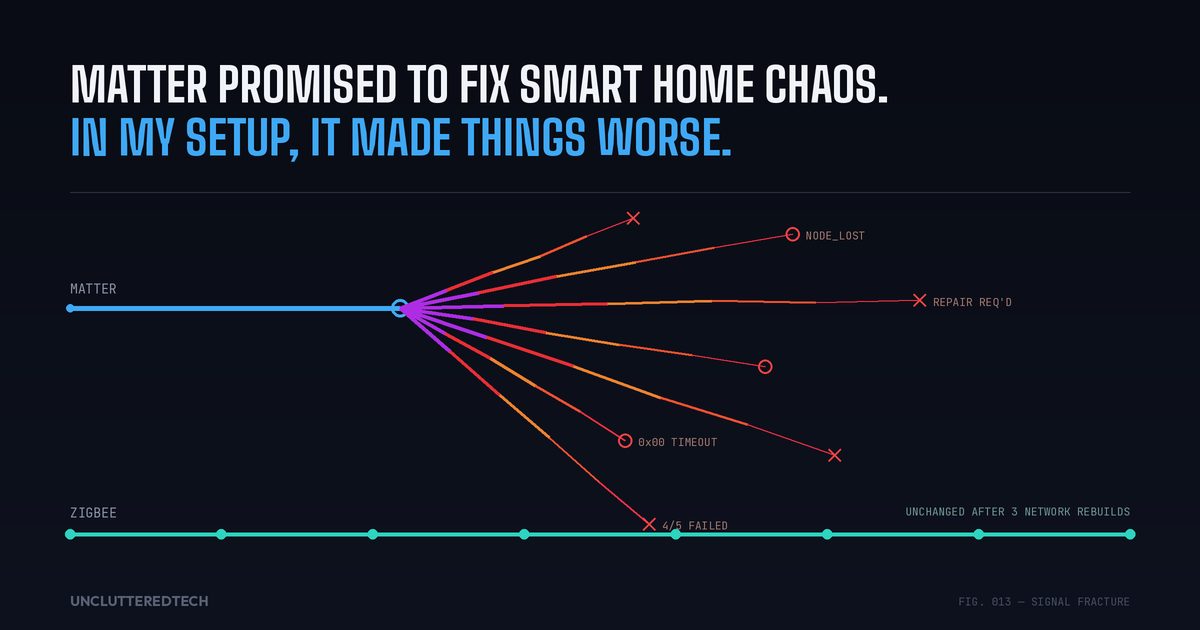
Six months after IKEA's Matter-compatible lineup hit the market, I bought nearly all of it. Four out of every five devices gave me pairing problems.
That's not a one-off. That's been my experience with Matter almost every time I've tried it.
I live in a 650 sq ft apartment with a genuinely solid network — 1.5 Gbps fiber, Unifi prosumer gear throughout. There's nothing on my network that should be causing interference or pairing failures. Out of roughly 50 connected devices in my smart home, less than 10 are actually paired over Matter. The rest run on Zigbee. That ratio isn't an accident — it's the result of Matter devices repeatedly failing me and Zigbee devices repeatedly not.
Here's what's actually happened, and why I think the problem isn't technical.
My Setup, Briefly
I run a mix of Home Assistant, a Homey Pro Mini, and Apple Home. Lights, plugs, fans, smart AC units, motion and presence sensors — a fairly typical mid-size smart home, not an exotic edge case.
At one point I had six separate hubs running. I've since consolidated to three: Home Assistant (on a mini PC, with a Zigbee/Matter USB dongle) bridges devices that Homey doesn't support yet — my Dreo fans and AC units, for example. A Philips Hue hub runs all my Philips Hue lights, plugs, and sensors. Homey handles the rest. Apple Home sits on top as the single app where everything shows up, regardless of which hub it's actually connected through.
That consolidation project is the whole reason Matter mattered to me in the first place.
What Matter Devices Actually Do When You Pair Them
Once a Matter device is paired, it's usually fine — connection reliability day-to-day is okay. The problem is everything around that moment.
Pairing itself is unreliable. A couple of sensors are Matter-only, no Zigbee fallback. More than once, they've dropped off and needed a full factory reset — sometimes several — before they'd pair again. Compare that to my Zigbee devices: I've changed SSIDs, rebuilt networks, and physically moved things around the apartment repeatedly. The Zigbee devices reconnect. The Matter ones, in my experience, often don't without starting from scratch.
Range is worse than advertised, even in a small space. My apartment is roughly 30x20 feet. There's no reason a device in the bedroom — the farthest point from my router — should have intermittent connectivity. But some Matter devices do: working fine, then dropping for a few days, then reconnecting on their own with no intervention from me. I haven't fully diagnosed it. I've just learned to live with it.
Multi-hub pairing is fragile by design. Part of Matter's promise was pairing one device to multiple hubs. In practice, that means putting a device back into pairing mode, connecting it to a second hub, and hoping it doesn't silently drop from the first one. When it does, you're redoing the whole setup.
The Control Group: Philips Hue
I've been running Philips Hue since before Matter existed — some of my bulbs are over ten years old. I haven't replaced a single one. The only bulb that ever gave me trouble was defective out of the box, and I knew it immediately.
My Hue setup runs entirely on Zigbee through its own bridge. It's the most rock-solid part of my entire smart home. Occasionally the bridge takes a minute to reconnect after a power outage. That's it. I don't repair devices, I don't factory reset anything, I don't think about it.
The point isn't that Hue is a better brand. It's that a mature, single-vendor Zigbee ecosystem has been more reliable over a decade than a cross-vendor "universal" standard has been over the past few years. That's the opposite of what Matter was supposed to deliver.
Why I Bought a Homey Pro Mini — and Why It Didn't Fix Anything
I got into smart homes a few years ago and, like a lot of people who love tech, went overboard: Alexa, Google Home, and Apple Home running in parallel at one point. Matter's original pitch was exactly what I wanted — pair everything once, have it work everywhere.
I bought the Homey Pro Mini specifically because it promised strong Matter support and better interoperability. I like the device — automations are genuinely easy to build. But it hasn't solved the problem I bought it for. Devices like my Dreo fans and AC units still don't pair reliably through it, even with a community integration. I was finally able to get the same devices paired into Home Assistant without issue.
So today, Home Assistant is a bridge for what Homey can't handle, Homey runs most of the rest, and Apple Home is the single pane of glass on top. That's three layers to do what Matter was supposed to reduce to one.
Why I Think This Is Happening
None of this is Homey's fault, or Home Assistant's, or even really IKEA's. I think it comes down to incentives.
Matter, the protocol, is a good idea. But it's implemented by for-profit companies that are optimizing for their own ecosystem first. A company's priority is making sure their product works well within their own app and their own hub on day one. Whether it plays nicely with a competitor's hub through a shared standard is a secondary concern — not because anyone's acting in bad faith, but because that's not where the financial incentive points.
Building a product that works within your own walled garden is a solved problem. Building one that genuinely interoperates with every other vendor's implementation of the same spec is a much harder, less rewarded problem. Companies are shipping "Matter compatible" because the market is asking for it, not because they're fully invested in making it work seamlessly across brands.
The Verdict
Matter has promise. It doesn't have results — not in my setup, not yet. I've mostly stopped buying Matter-only devices, and where I can, I factory-reset and re-pair things over Zigbee instead, because Zigbee has simply been more reliable for me.
I think it'll take real consumer pushback before vendors treat cross-brand compatibility as more than a checkbox. Until then, if you're building a smart home from scratch, I'd lean toward mature Zigbee devices — Hue being the clearest example in my own setup — over anything marketed primarily as "Matter compatible."
If you've had a smoother experience with Matter than I have, I'd genuinely like to hear what's different about your setup. I'm not ruling out that I'm missing something — but four failed pairings out of five brand-new IKEA devices is hard to write off as bad luck.
Disclosure: Some links in this post may be affiliate links. I earn a small commission at no extra cost to you. I only link to products I actually own and use.