Let me save you some time: yes!
But that's not a very interesting blog post, so let me tell you why — and what I learned after a decade of trying to find something better.
How It Started
I bought my first Philips Hue bulbs about ten years ago, back when smart lighting was still a novelty and the price per bulb felt genuinely shocking. I remember justifying it the way most people do — one starter kit, just to try it out.
That was the beginning of a slow, room-by-room takeover.
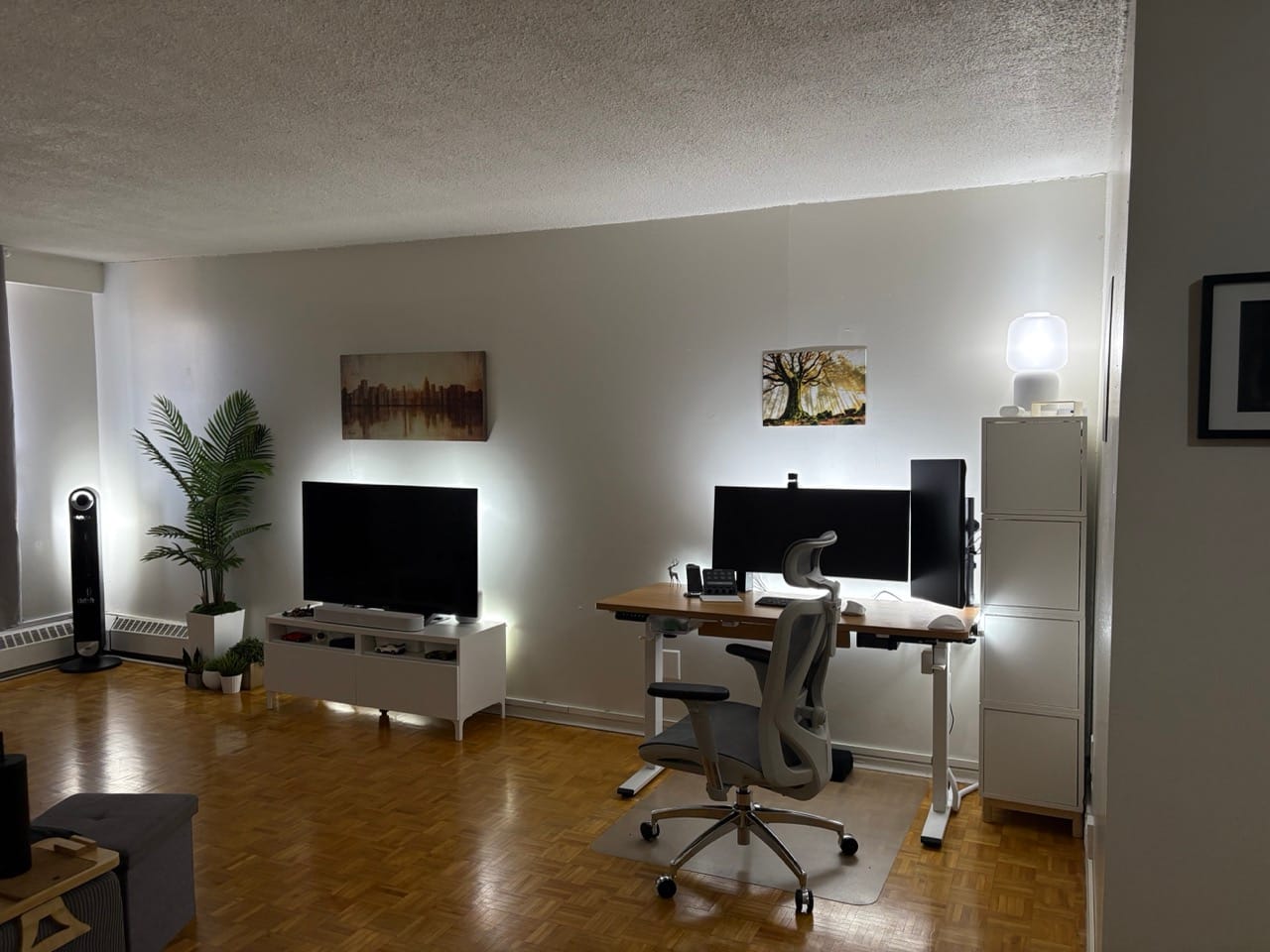
Today, every room in my 650 square foot Montreal apartment runs on Hue. Bulbs in the living room and bedroom. Lightstrips behind the TV stand, bedroom dresser, and headboard. Light bars behind the TV and tower fan. Smart plugs controlling my charging station. Dimmer switches throughout the apartment. Twenty to twenty-five items in total, at roughly $1,200 invested over a decade.
Not a single one has burned out. Not one has dropped off the network mysteriously. Not one has required a factory reset because it stopped responding.
For smart home gear, that's remarkable.
What I Actually Have
The Hue ecosystem in my apartment covers everything:
- Bulbs — E26 colour bulbs in the main living areas and bedroom
- Lightstrips — behind both monitors on my desk, the TV stand, and accent lighting throughout
- Hue Play light bars — behind the TV and tower fan for bias lighting.
- Smart plugs — controlling items in my network cabinet and my device charging station.
- Dimmer switches — throughout for anyone who prefers a physical switch.
All of it runs through a Hue Bridge connected to my UniFi network, and integrates natively with Apple HomeKit via my HomePod acting as a hub. Automations, scenes, presence detection — it all just works.
What I Tried Instead
Over ten years I've been curious enough — and minimalist enough — to question whether I actually needed to keep paying the Hue premium. So I tested the alternatives.
Govee — Affordable, visually impressive in the marketing photos. In practice, the app is bloated, cloud-dependent, and the HomeKit integration was unreliable. Returned.
Nanoleaf — Beautiful panels, genuinely creative product. But the connection process was finicky, the panels didn't play well with the rest of my ecosystem, and they felt more like art installation than practical lighting. Got rid of them.
IKEA Trådfri / Dirigera — Solid value, and I still use IKEA switches as supplementary controls. But the bulbs themselves never felt as responsive or as colour-accurate as Hue. Fine as gap-fillers, not as a replacement.
SwitchBot — I use SwitchBot for other things in the apartment and like the brand. Their lighting products didn't match the rest of my setup well enough to keep.
Every time, I came back to the same conclusion: Hue is more expensive because it's better. Not marginally better. Noticeably better in my opinion.
What Makes Hue Different
After a decade of using it and comparing it to everything else, here's what actually separates Hue from the competition:
Reliability
This is the one that matters most and gets talked about least. Smart home gear that works 90-95% of the time is frustrating to live with. You start to distrust it. You add friction back into your routines because you can't count on the automation.
Hue works 100% of the time. In ten years I have not had a single bulb drop off my network unexpectedly, fail to respond to a command, or require troubleshooting. That consistency is worth paying for.
Local Control
Hue's Bridge processes commands locally. That means your lights respond instantly — no round trip to a cloud server, no latency, no dependency on Philips' servers being up. When my internet goes down, my lights still work.
Most cheaper alternatives are cloud-dependent. That matters more than most people realize until they've lived with both.
HomeKit Integration
Native, rock-solid, no third-party bridges or workarounds required. Scenes, automations, and Siri commands all work exactly as expected. For an Apple household this is non-negotiable.
Colour Accuracy
If you care about the quality of light in your home — and as someone living in 650 square feet, I care quite a bit — Hue's colour rendering is noticeably better than the competition. The whites are cleaner. The colours are more accurate. The dimming curve feels natural.
The Honest Downsides
Hue is not perfect. Two real criticisms:
The price is high. There's no getting around it. A single Hue colour bulb costs what a four-pack of a competing brand costs. If you're outfitting a large home from scratch, that adds up fast.
The app has gotten bloated. The original Hue app was simple and well-designed. The current version has too many features, too many tabs, and a subscription tier (Hue Bridge 2.0 with some advanced features) that feels unnecessary for most users. I use HomeKit for 90% of my interactions with the lights specifically to avoid opening the Hue app.
Is It Worth It in 2026?
For me, yes — unconditionally. The combination of ten years of zero failures, genuine local control, flawless HomeKit integration, and the best colour quality I've found at this price point makes Hue the easy choice for a smart home that's meant to disappear into the background.
If you're a minimalist — if the goal is technology that works quietly without demanding your attention — Hue earns its place in a way that cheaper alternatives haven't, at least in my experience.
The starter kit is the right place to begin. Two bulbs and a Bridge. Live with it for a month. If you're like me, you'll be back for more.
Affiliate disclosure: some links below are Amazon.ca affiliate links. I earn a small commission at no extra cost to you. I only link products I own and have used personally.
Gear Mentioned
| Item | Notes | Link |
|---|---|---|
| Philips Hue Starter Kit (2 bulbs + Bridge) | Best place to start | View on Amazon.ca |
| Philips Hue Colour Bulb E26 | Add-on bulbs | View on Amazon.ca |
| Philips Hue Lightstrip Plus | Behind monitors, under furniture | View on Amazon.ca |
| Philips Hue Play Light Bar | TV bias lighting | View on Amazon.ca |
| Philips Hue Smart Plug | Control non-smart lamps | View on Amazon.ca |
| Philips Hue Dimmer Switch | Physical wall controls | View on Amazon.ca |