Intentional Purchasing: How I Decide What Tech Is Worth Buying
The 3 Questions I Ask Before Buying Any New Tech
I don't buy tech because it's new. I buy it because it earns its place.
That sounds simple, but most tech doesn't pass the test. It promises to save time and ends up costing it — in setup, in troubleshooting, in the mental tax of one more thing to manage. Simplifying my life means being deliberate about what I let in. If a device or service doesn't reduce friction, save time, or make a specific task easier, it doesn't stick around.
Tech has to earn its place
A good spec sheet doesn't mean much to me. What matters is how something feels to use, day after day, once the novelty wears off. That's the real test — not what a product can theoretically do, but what it actually does for me once it's part of my routine.
This also shapes how I think about upgrading. I don't buy the newest model by default. I ask whether last year's version, or a refurbished one, does the job just as well. That one question kills most impulse purchases before they start.
Three questions before I buy anything
Does the friction end?
Every new tool has a learning curve. The question is whether that curve flattens out, or whether the tool keeps demanding attention months later.
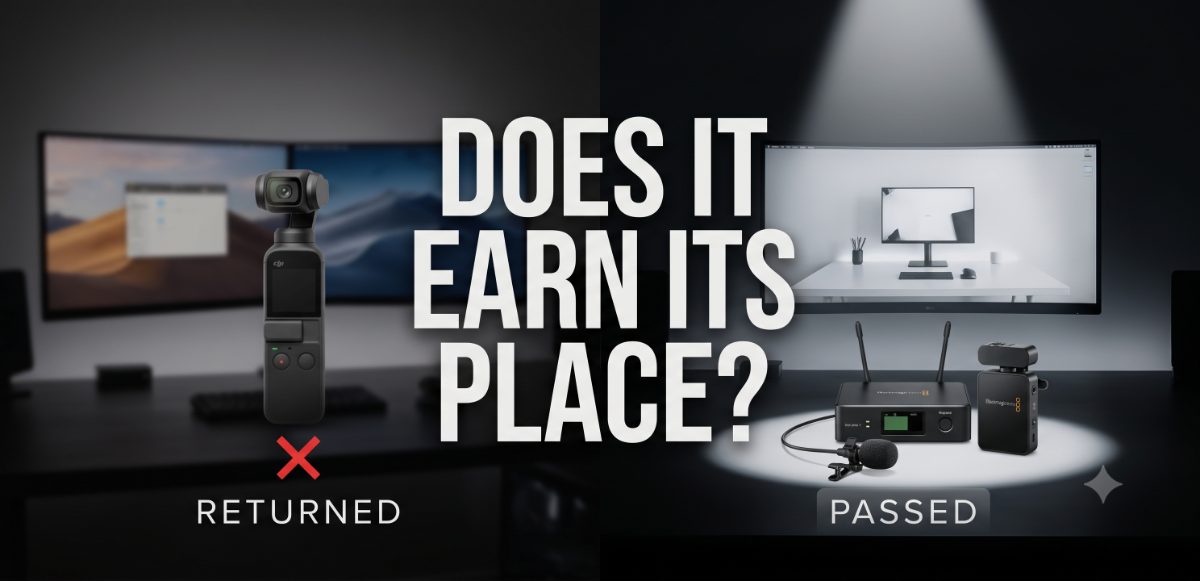
I bought a DJI Osmo Pocket 3 for my YouTube production, on sale, thinking it would speed things up. The gimbal stabilization is genuinely good, but I couldn't figure out how to lock it to a fixed point, and locking onto a subject was exactly what I needed for the shots I wanted. On top of that, the footage wasn't as sharp as what I was already getting from my iPhone 16 — the difference was obvious, and it meant more editing, not less. I kept reaching for my phone to reshoot the same thing I'd bought the Pocket 3 for. Sent it back.
What am I really getting in return?
Not "productivity." Not "convenience." I need something specific — time saved, a step removed, a task I genuinely couldn't do before.
I picked up a second 34-inch ultrawide, thinking dual ultrawides would take my workflow up a level. The monitor itself was fine. But in practice, I found myself preferring a single screen I look straight at over turning my head between two. The extra real estate sounded good on paper. It wasn't worth the tradeoff in daily use. That one went back too.
How do I feel when I step away from it?
This is the question that tells me the most. Once I've finished using something, am I relieved it's done, or do I miss it?
My lavalier mic setup is the clearest recent win. I'd been using an Elgato Wave 3 — a solid mic, but fixed in place. Switching to a lav mic I can clip on and move with means better directional audio and no anxiety about staying in one spot to be heard clearly. A year in, I still haven't second-guessed that purchase.
Guardrails against hype
A cool-down period. I don't buy tech right after launch. Waiting a few weeks lets the marketing noise settle and the real reviews show up — the ones from people who've actually lived with the thing, not just unboxed it. Most of what's on my "maybe" list dies quietly during this wait.
Total cost, not sticker price. Before I look at a product, I set a budget — and it includes the accessories, subscriptions, and repairs that don't show up on the price tag. A cheap device that needs expensive extras isn't actually cheap.
Skepticism toward polish. Overly produced reviews and affiliate-driven "best of" lists tell me less than a pile of ordinary user complaints on a forum. I look for patterns across real, unglamorous use — not a single glowing take.
My checklist
- What specific problem am I solving? Not a vague itch — a defined gap.
- How will I know it worked? A concrete outcome I can point to later.
- What's the full cost, accessories and subscriptions included?
- What are the realistic alternatives — last year's model, refurbished, or no purchase at all?
- Does it fit cleanly into what I already use, or does it create a new silo?
- What do long-term users say, not just launch-day reviewers?
- Net-net: does this simplify my life, or add another thing to manage?
What actually passes
Looking back, the purchases that held up share a pattern: they do one job well and then get out of the way. The lav mic. A monitor I actually look at instead of two I turn my head between. Tools that don't ask me to think about them once they're set up.
The ones that failed the test — the Osmo Pocket 3, the second ultrawide — weren't bad products. They just didn't earn a place in how I actually work.
The takeaway
Intentional purchasing isn't a one-time decision, it's a habit. Before I buy, I ask what problem this solves, what I get in return, and how I'll feel once the new-gadget shine wears off. Most tech doesn't survive that filter. The stuff that does ends up quietly running my business instead of running my attention.