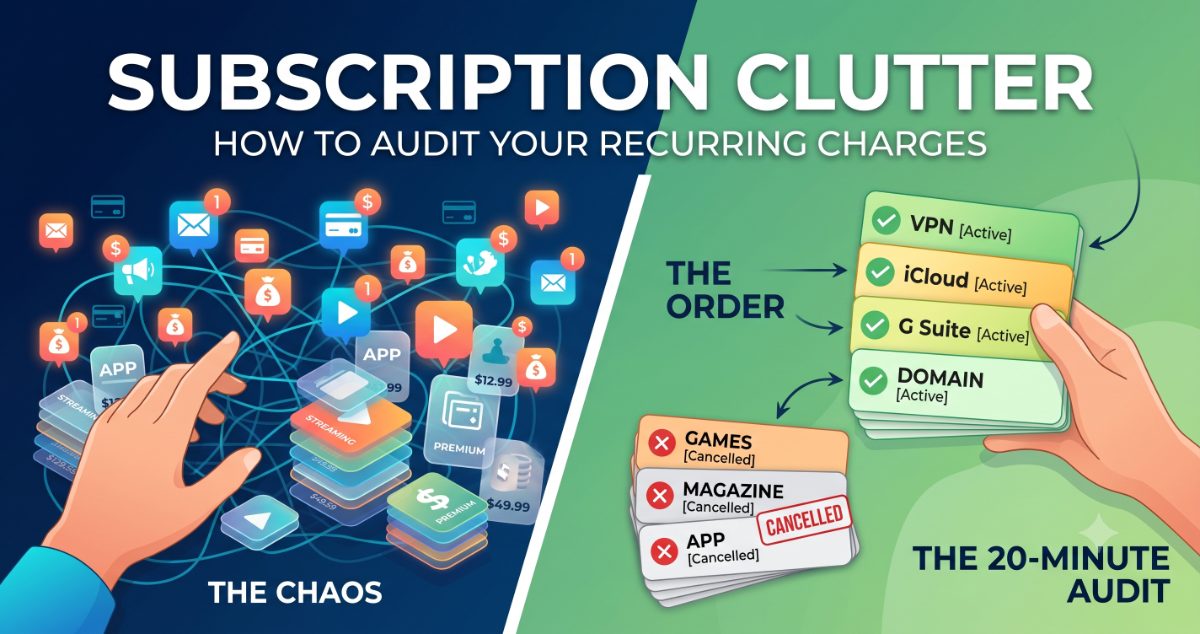
Every few months I go through the same exercise: list every subscription I'm paying for, and ask if it still earns its spot. Most people never do this. They sign up for a free trial, forget to cancel, and three years later they're paying for something they haven't opened since 2023.
This isn't a budgeting post. It's a decluttering post — the same principle I apply to cables and apps, applied to recurring charges.
Why subscriptions are the hardest clutter to see
Physical clutter is visible. A drawer full of old cables tells you something's wrong the moment you open it. Subscription clutter is invisible — it's a line on a statement you don't read closely, charged automatically, month after month. That's what makes it dangerous: it doesn't nag you the way a messy desk does, so it never forces the decision.
My audit method
I run this quarterly. Takes about 20 minutes.
1. List everything. Every tool, every app, every service that charges you on a schedule. Don't rely on memory — pull your bank and credit card statements for the last two months and write down every recurring charge you see, including the ones you don't recognize at first glance.
2. Sort into three buckets. For each one, ask: do I use this weekly? If yes, it stays without a second thought. If it's monthly or occasional but genuinely valuable, it's a maybe. If you can't remember the last time you opened it, it's a cut.
3. Check the annual cost, not the monthly one. $12.99/month sounds harmless. $155.88/year next to four other tools that all sound harmless is how you end up with a five-figure yearly total without noticing.
4. Cancel in the moment. Don't add it to a to-do list for "later." Later doesn't come. Cancel it while you're looking at it.
My real numbers
Here's my current tech subscription stack, pulled straight from my own tracker:
Active:
- 1Password — $84/year
- iCloud+ 200GB — $4.59/month
- Bell Internet — $109/month
- Claude Pro — $33/month
- Contabo VPS — $42/semi-annual
- Descript — $50/month
- Google One Pro — $264/year
- Rogers Wireless (covers 5 lines) — $233/month
- My 2 domain renewals — $20/year each
Cancelled or in the process of cancelling: Fastmail, Squarespace, SuperWhisper, Quicken, Microsoft 365, Parallels, a Google Workspace Starter account, Hostinger.
That's nine services I decided weren't earning their spot. Some were straightforward — a Squarespace plan for a site I'd already rebuilt elsewhere. Others took longer to admit, like Microsoft o365, which I kept renewing out of habit more than use.
The point isn't the specific tools. It's that nine cancellations is what a real audit finds when you actually sit down and look, instead of assuming your subscription list is fine because nothing "feels" expensive.
What to do with this today
Open your bank app right now, filter for the last 60 days, and write down every recurring charge you see. You don't need a spreadsheet or an app to start — a notes app and 20 minutes is enough. Do the sorting exercise above. You'll probably find at least one thing you forgot you were paying for.
That's the whole system. No hacks, no app subscription to track your app subscriptions. Just a recurring 20-minute habit that keeps your tech spend as intentional as everything else you own.